
The Regenerative Design System translates circular principles into high-performance, net-positive products that recover capital and build brand equity through measurable ecological Handprints.
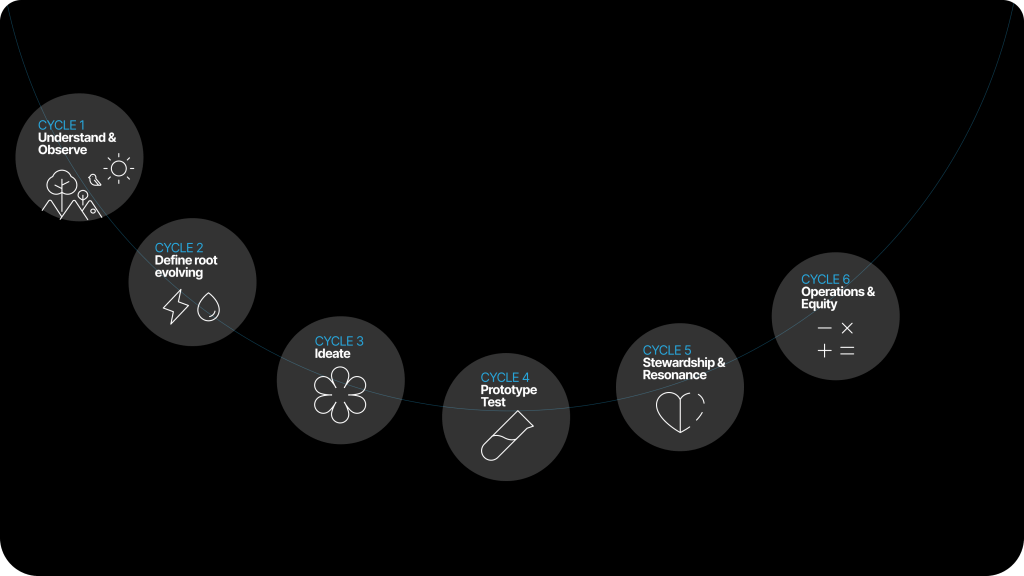
Core Philosophy
The system operates at the intersection of regenerative design and the Circular Innovation Process, translating abstract circular principles into tangible, scalable solutions. Our ultimate goal is to move beyond merely doing less harm and instead create products that are ecologically restorative, giving back more than they take over their entire life cycles.
Circular Economy Principles
- Design out waste and pollution.
- Circulate products and materials.
- Regenerate nature.
Cradle to Cradle Principles
- Waste equals food.
- Use current solar income.
- Celebrate diversity.
The Aesthetic of Stewardship
Utility is the baseline, but beauty is the catalyst for preservation. By applying disciplined geometry, minimalist precision, and material integrity, we transform functional tools into objects of sublime beauty. This aesthetic precision is not merely decorative: it is a functional requirement to foster deep stewardship, ensuring that products are cherished, maintained, and actively returned to their cycles rather than discarded.
- Biomimetic Efficiency (Form follows flow).
- Net-Positive Integration (Handprint Logic).
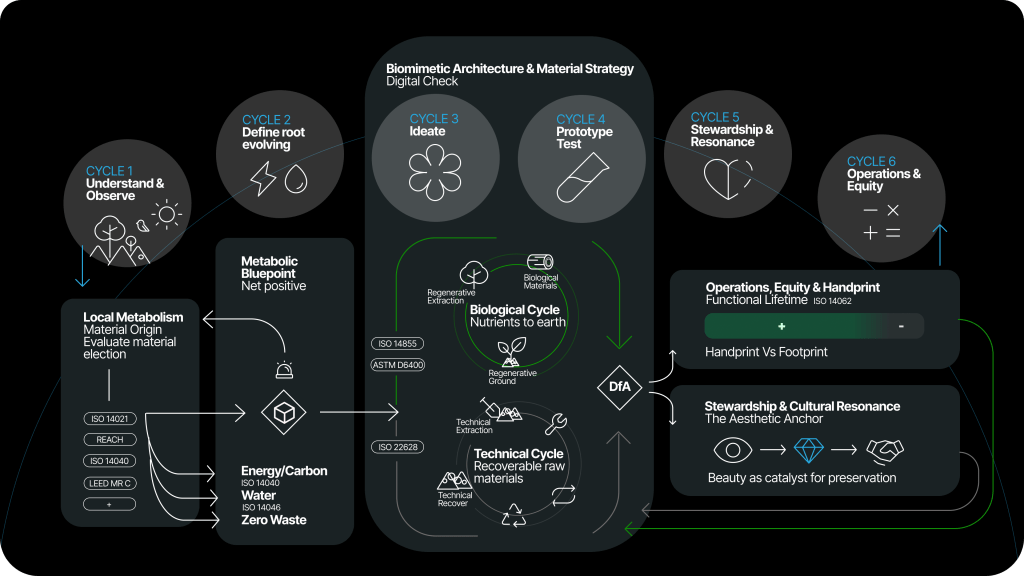
Cycle 1: Understand & Observe (Ecosystem & Place)
- Goal: Audit local metabolism and establish system boundaries.
- The Core: Stop relying on blind global supply chains. Map and utilize available regional biomaterials and waste streams to design for the specific local ecosystem.
Cycle 2: Define (The Metabolic Blueprint & Net Positive Rules)
- Goal: Shift from Net-Zero damage to Net-Positive restoration.
- The Core: The ultimate kill/go filter. Set unbreakable rules for water, energy, and toxicity. If the concept isn’t 100% Cradle-to-Cradle, the idea dies here.
Cycle 3: Ideate (Biomimetic Architecture & Material Strategy)
- Goal: Eradicate toxics and engineer for separation.
- The Core: Form follows biological efficiency. Eliminate all Red List chemicals and replace permanent adhesives with modular, mechanical joints using the absolute minimum material.
Cycle 4: Prototype & Test (Eco-Materialization & The Cycle of Life)
- Goal: Simulate and audit the product’s end-of-life.
- The Core: The physical stress test. Enforce the “3-Minute Disassembly Rule” to guarantee profitable recycling and validate true biodegradability standards.
Cycle 5: Stewardship & Cultural Resonance (The Legacy Loop)
- Goal: Create emotional durability to prevent premature disposal.
- The Core: The psychological anchor. Sublime beauty and functional perfection ensure the object is culturally cherished, transforming consumers into active stewards of the material loop.
Cycle 6: Operations, Equity & System Rollout
- Goal: Execute logistics that prevent the product from becoming landfill.
- The Core: Deploy Product-Service Systems (PSS). Retain ownership of materials through reverse logistics, turning past products into your future supply chain.




Leave a Reply