Industrial Design | Circular Economy | Data Analytics
The Invisible Backpack Whenever we talk about sustainability, we hear about the “Carbon Footprint.” But for industrial designers, there is a more specific, powerful metric: Embodied Carbon.
Think of it this way: while a footprint tells the entire story of an object’s life, Embodied Carbon is the “Invisible Backpack” it wears the moment it reaches its destination. It is the “smoke trail” of CO2 left behind from raw material extraction until it reaches your front door. If the backpack is heavy, the planet pays the price.
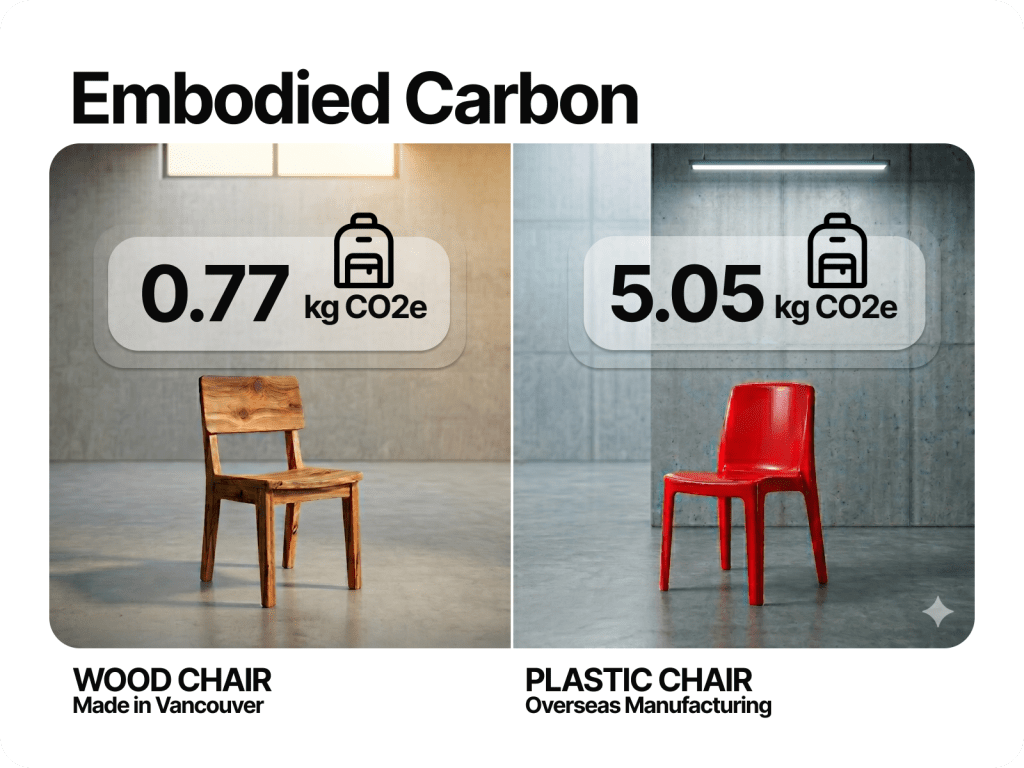
The Chair Duel: Wood vs. Plastic To measure this impact, I designed two chairs of identical weight (800 grams). Their physical weight is the same, but their invisible backpacks are massively different.
- The Wood Chair (Made in Vancouver)
- Sourcing: Local timber (acts as a carbon sink during growth).
- Process: Low-energy cutting and sanding.
- Transport: Local logistics, minimal fuel.
- Backpack Weight: 0.77 kg CO2 (Light footprint)
- The Plastic Chair (Imported from China)
- Sourcing: Extracted petroleum.
- Process: High-heat injection molding in giant machines.
- Transport: Transoceanic shipping.
- Backpack Weight: 5.05 kg CO2 (Heavy footprint, roughly 7x the wood chair)
The Three Carbon Villains Why the massive discrepancy? A product’s backpack fills up based on three primary factors:
- The Material: Nature-made elements (wood, fibers) are inherently cleaner than synthetics (plastics, aluminum).
- The Heat: Manufacturing processes requiring high temperatures to melt or burn materials exponentially increase emissions.
- The Trip: Globalized supply chains add massive transportation carbon weight.
The Outcome: The Designer’s Superpower Design is not just about making things look cool; it’s about making sure their invisible backpack doesn’t weigh more than the object itself. We have the agency to choose:
- Specify materials that “breathe” and regenerate.
- Implement Design for Disassembly to eliminate adhesives and complex hardware.
- Localize production to slash transport emissions.
The next time you evaluate a product, ask yourself: How heavy is its backpack?
The embodied carbon emissions presented were estimated using the 2030 Calculator
by Doconomy. The calculation was performed using a “Cradle-to-Gate” approach, evaluating raw material extraction and manufacturing processes for both the local wood and injected plastic, alongside estimated overseas transportation logistics.
 Gerardo Pena
Leave a comment