Where does your product’s life cycle end?
In contemporary operational management and industrial design, the line separating a company that consumes resources from one that builds assets is defined by a single systemic question.
To understand true sustainability and its direct impact on the financial balance sheet, it is imperative to abandon the linear vision. In circular innovation architecture, you analize the metabolism of production systems through two fundamental flows: Open Loops and Closed Loops
1. Open Loops: The Trap of Linear Extraction
An open-loop system operates under a unidirectional flow: extraction, manufacturing, use, and disposal.
The Origin: This model consolidated during the Industrial Revolution, sustained by the economically flawed premise that planetary resources are inexhaustible and the biosphere’s assimilation capacity is infinite. The Ellen MacArthur Foundation documents this “Take-Make-Waste” model as the primary driver of the current climate and resource scarcity crisis (Ellen MacArthur Foundation, 2013).
The Operational Leak: In an open-loop system, waste is passively accounted for as an inevitable operational cost. The capital, energy, and labor invested in the material are destroyed upon reaching the landfill. Financially, the company pays a double penalty: the initial purchase of raw materials and the subsequent waste management fees. It is a silent but constant capital leak.
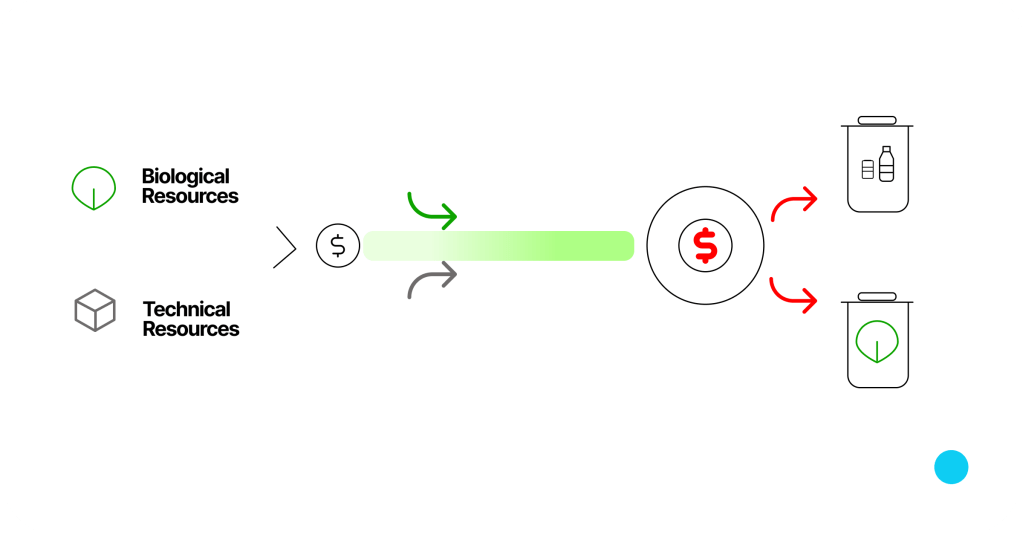
2. Closed Loops: Systemic Regeneration
A closed-loop system, in contrast, mimics the metabolic efficiency of the natural world, where the concept of “waste” does not exist. The end of one element’s life cycle is the beginning of the next.
The Origin: This methodology is founded on the Cradle to Cradle framework, articulated by architect William McDonough and chemist Michael Braungart. Its guiding principle states that “waste equals food” (McDonough & Braungart, 2002).
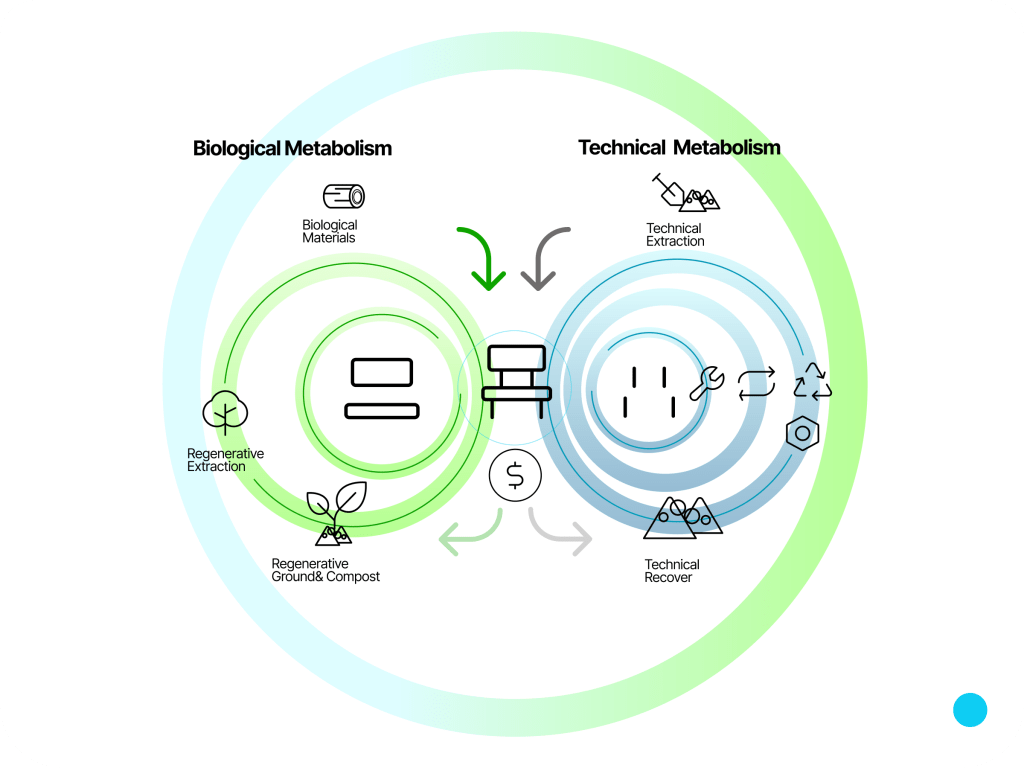
The Flow Architecture: Material value is preserved by dividing resources into two isolated metabolisms:
The Biological Cycle: Toxin-free materials (such as FSC-certified paper or plant-based inks) designed to biodegrade and safely reintegrate into the earth as biological nutrients, regenerating the local ecosystem.
The Technical Cycle: Inorganic elements (high-density polymers, recycled aluminum) designed under strict Design for Disassembly (DfA) parameters to be recovered and reintroduced into manufacturing without loss of purity or quality.
The Business Case: Why is it a Financial Imperative?
The adoption of closed loops transcends ecological responsibility; it is a strategy for economic survival and corporate resilience.
1. Capital Recovery (Cost Avoidance) Closing a linear flow seals a liquidity leak. Implementing reverse logistics or on-site composting systems diverts tons of material from the landfill, which translates into a mathematical, measurable reduction in waste management bills. Capital is retained within the operation.
2. Supply Chain Risk Mitigation Reliance on open loops exposes operations to the volatility of global raw material prices. By transitioning to a closed loop—where the company “harvests” technical components from its own products—the operation becomes resilient and independent of extractive market fluctuations.
3. Building Brand Equity (Handprints) Modern standards, such as the Living Product Challenge (International Living Future Institute, 2022), demand moving beyond harm reduction to generate Handprints: net-positive impacts. A system designed under the precision of a closed loop transforms into an object of care. This aesthetic and operational transcendence elevates brand positioning, justifying its premium value and strengthening user loyalty, as the user now acts as an active steward of the ecosystem.
The Operational Perspective
The historical failure of ecological initiatives lay in treating environmental design as a public relations exercise. Ecology and economy respond to the same laws of conservation. If the end of a product’s life cycle is not mapped, financial optimization is impossible. The future of high-performance design demands architectures where every material, guided by impeccable technical precision, remains in perpetual motion.
References:
- Ellen MacArthur Foundation. (2013). Towards the Circular Economy: Economic and business rationale for an accelerated transition.
- International Living Future Institute. (2022). Living Product Challenge Standard.
- McDonough, W., & Braungart, M. (2002). Cradle to Cradle: Remaking the Way We Make Things. North Point Press.


Leave a Reply