Nature is not just a backdrop; it is our biological infrastructure, and our physical products must learn to exist within its limits.
In my practice as an industrial designer, I’ve realized that form and function are no longer enough. To ensure our creations respect these biological boundaries, design needs to shift from a linear model to a metabolic one.
The main challenge, however, is that we can’t manage what we don’t measure. For many designers and studios, calculating a material’s true impact is an opaque, frustrating process. Decisions are often driven by intuition. What is the real impact of a component made from virgin aluminum versus a recycled one? How does sourcing components Imported from Overseas affect the total footprint? Without a tangible tool, sustainability remains just a nice intention.
To bridge this gap, I built EcoMaterialize. My approach combines systems thinking with the practical constraints of everyday industrial design, integrating carbon data directly into the creative process. The goal is straightforward: design so that every component can be easily processed, adapted, or reintegrated. To make this accurate, I pulled trusted data from international benchmarks like the ICE database and 2030 Calculator standards.
How to use EcoMaterialize V1
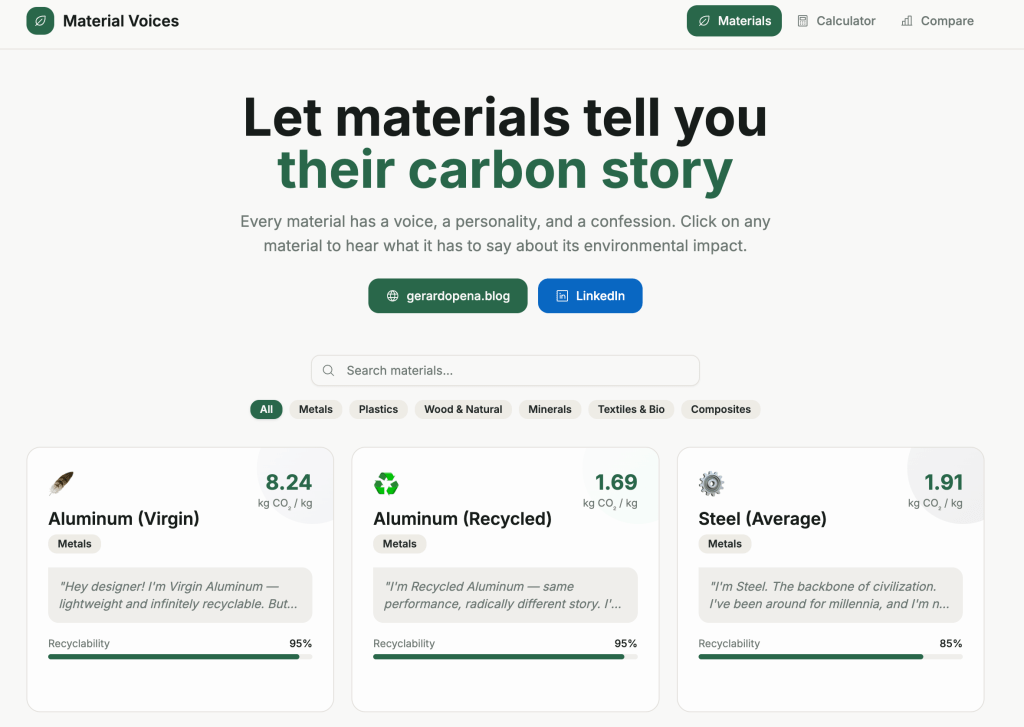
This tool is designed to be an intuitive companion during your material selection process. Here is how to get the most out of it:
- Explore the Material Cards: Each card represents a “Material Voice.” Start by browsing through the library to see the baseline embodied carbon (kgCO2e/kg) for common industrial materials.
- Read the Data: Beyond the main number, pay attention to the source and the boundaries. The tool focuses on “Cradle-to-Gate” impact, helping you understand the footprint of a material before it even reaches your assembly line.
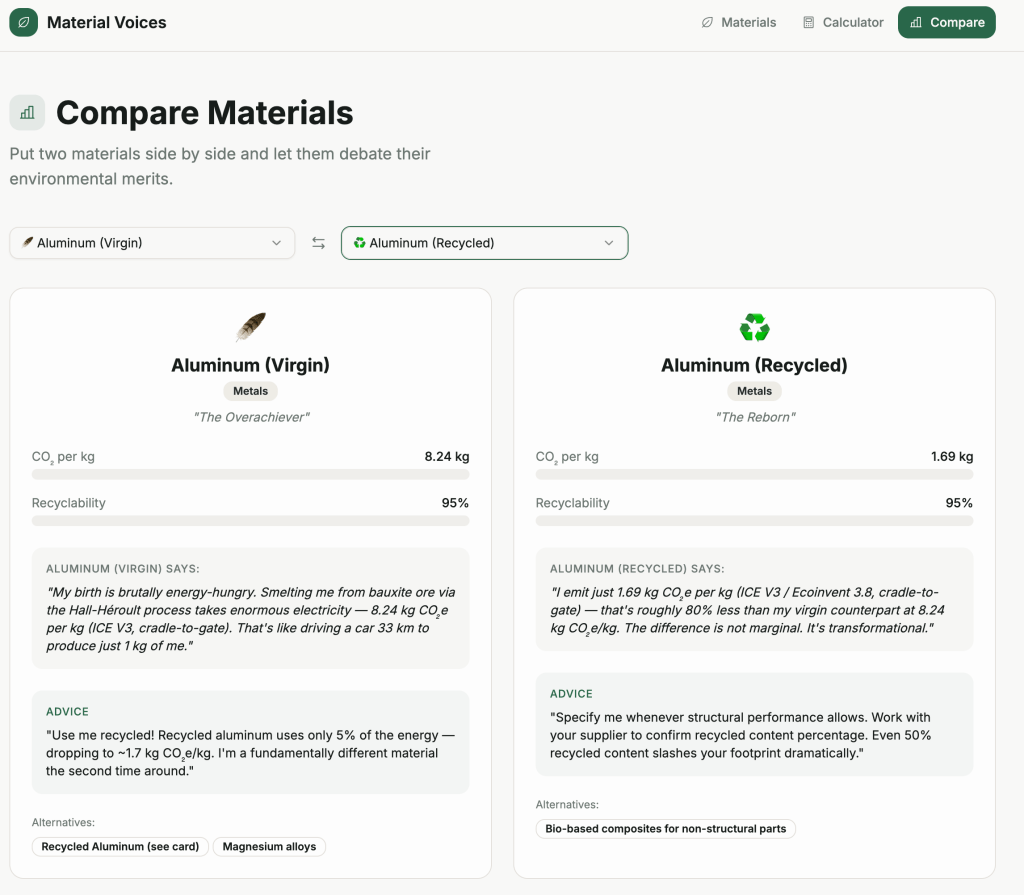
- Compare and Iterate: The real power of the calculator lies in comparison. Try toggling between virgin and recycled options—for instance, you’ll see the carbon footprint of aluminum drop from 8.24 to 1.69 kg CO₂e/kg. Use these insights to justify design changes or material swaps in your projects.
- Calculate your Impact: Input the weight of your components to see the total “invisible weight” of your product. This allows you to move beyond guesses and present data-backed design solutions.
It’s an invitation to stop guessing and start building. I invite you to test the tool, audit your own projects, and take a tangible step toward a truly circular economy. Since this is Version 1, I am actively looking for feedback. Whether it’s a technical critique, a material suggestion, or an idea on how to improve the interface, your thoughts are welcome.
[Test EcoMaterialize V1 Here] (Link: https://eco-material-speak.base44.app/)


Leave a Reply